Apr 17, 2026
Agentic Generative Compression: AI Agents Redefining Data Efficiency
Explore how AI agents revolutionize data compression with generative techniques, enhancing efficiency and unlocking new possibilities in data management.
AI Agents Transforming Data Compression
In a world where data is growing exponentially, efficient data management has become a critical challenge. By 2025, global data is expected to reach 175 zettabytes, according to IDC. This staggering volume underscores the need for innovative solutions in data storage and transmission. Enter agentic generative compression, a cutting-edge approach that leverages AI agents to redefine data efficiency. These AI-driven systems are not only capable of learning and adapting to data characteristics but also excel in optimizing compression strategies dynamically.
Traditional data compression methods often struggle with complex, high-dimensional data. This is where generative models come into play. By learning the underlying data distributions, these models can compress various data types, including images and videos, more effectively. The integration of AI agents into this process allows for automated optimization of compression parameters, leading to improved compression ratios and enhanced data handling capabilities.
The implications of agentic generative compression are profound. For developers and AI enthusiasts, this technology offers a new frontier in data management, unlocking possibilities that were previously unattainable. As we delve deeper into the mechanics of this innovative approach, it becomes clear that AI agents are not just enhancing efficiency—they are transforming the very landscape of data compression.
Challenges in Traditional Data Compression
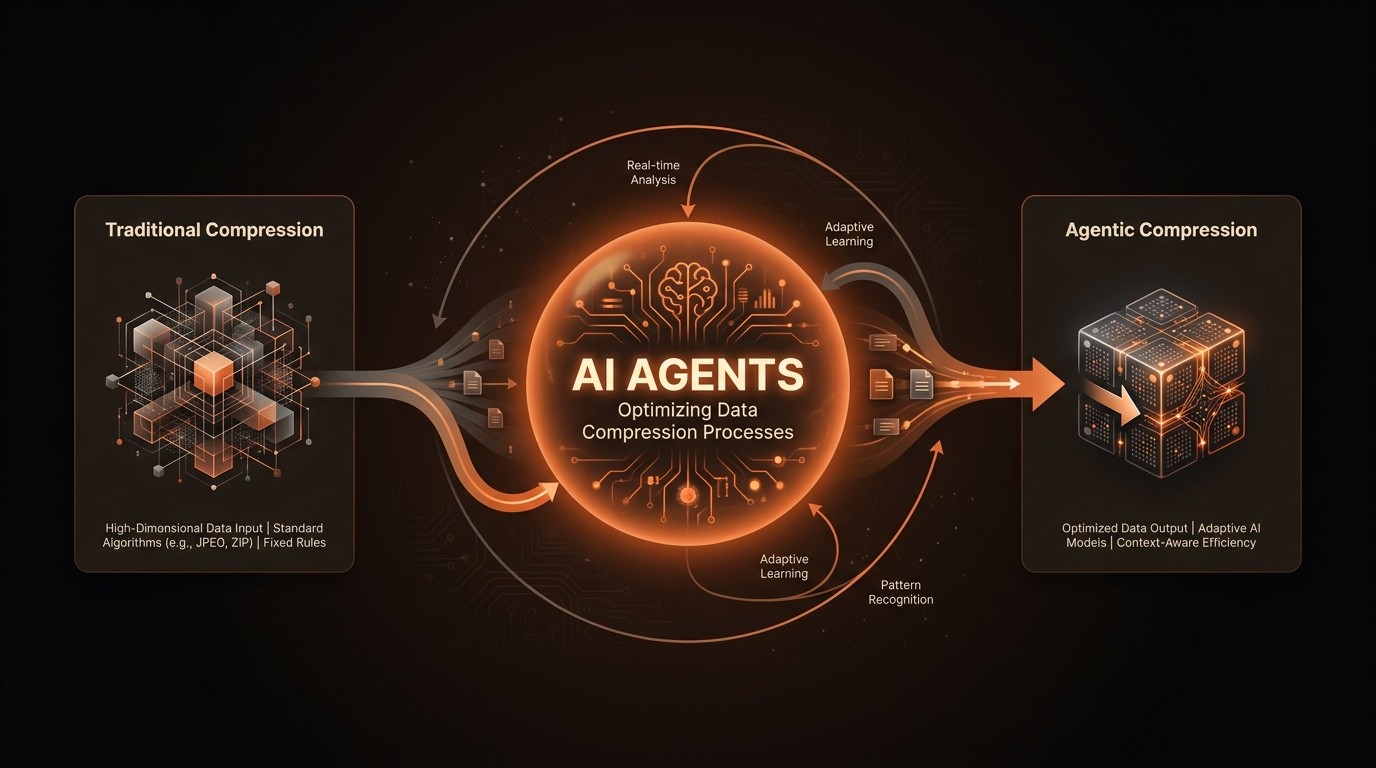
The traditional methods of data compression face several significant challenges, particularly when dealing with the ever-increasing complexity and volume of data. One major pain point is the inefficiency of handling high-dimensional data. Traditional algorithms often falter when tasked with compressing complex datasets, leading to suboptimal compression ratios and increased storage requirements. This inefficiency can result in higher costs and slower data transmission speeds, impacting businesses that rely on fast and efficient data handling.
Another challenge is the static nature of traditional compression algorithms. These algorithms typically apply a one-size-fits-all approach, which does not account for the unique characteristics of different datasets. This lack of adaptability can lead to poor performance, especially when dealing with diverse data types such as images, videos, and text. The inability to dynamically adjust compression strategies means that traditional methods often miss opportunities to optimize data storage and transmission.
Moreover, the manual optimization of compression parameters is both time-consuming and prone to human error. In many cases, achieving optimal compression requires extensive trial and error, which can be a significant drain on resources. This manual process not only slows down data handling but also increases the likelihood of errors that can compromise data integrity.
Finally, the growing demand for real-time data processing presents a formidable challenge for traditional compression methods. As businesses increasingly rely on real-time analytics and decision-making, the need for fast and efficient data compression becomes paramount. Traditional methods, with their inherent limitations, struggle to meet these demands, highlighting the need for more advanced solutions like agentic generative compression.
Understanding Agentic Generative Compression
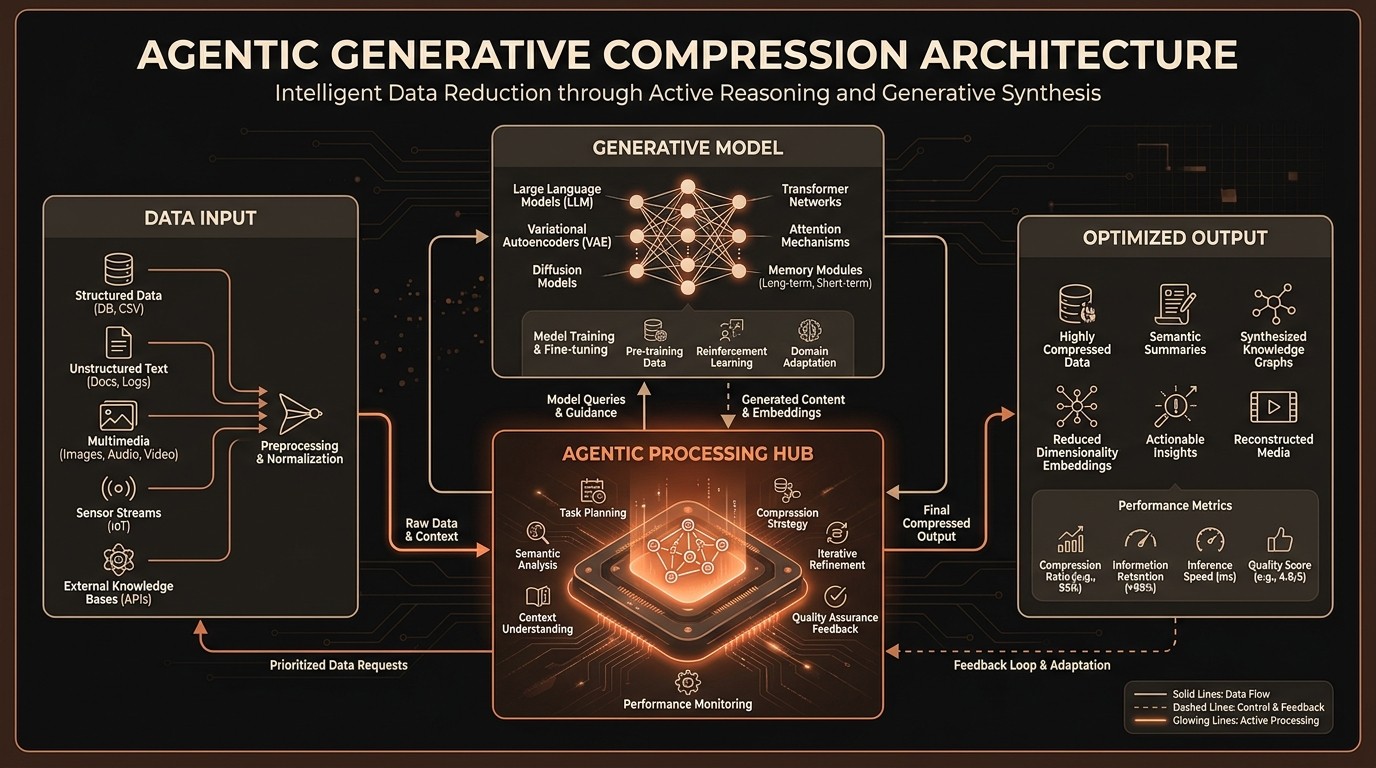
Agentic generative compression represents a paradigm shift in how data is managed and optimized. At its core, this approach leverages AI agents to dynamically adapt compression strategies based on the unique characteristics of the data being processed. This adaptability is a key differentiator from traditional methods, allowing for more efficient and effective data compression.
Generative Models
Generative models are a cornerstone of this approach. These models are designed to learn the underlying distributions of data, enabling them to generate new data points that are statistically similar to the original dataset. By understanding these distributions, generative models can compress data more effectively, reducing the amount of storage required without sacrificing quality. This capability is particularly valuable for compressing complex data types like images and videos.
AI Agents
AI agents play a crucial role in optimizing the compression process. These agents are capable of analyzing data characteristics in real-time and adjusting compression parameters accordingly. This dynamic adaptability ensures that the most efficient compression strategy is applied to each dataset, maximizing storage efficiency and minimizing transmission times. The integration of AI agents into the compression process represents a significant advancement over static, traditional methods.
Dynamic Adaptation
The ability to dynamically adapt compression strategies is a hallmark of agentic generative compression. This adaptability is achieved through continuous learning and feedback loops, allowing AI agents to refine their strategies based on real-world performance data. This iterative process ensures that compression remains optimized even as data characteristics change over time, providing a level of efficiency that static methods cannot match.
VideoDB Integration
For platforms like VideoDB, which handle vast amounts of video data, agentic generative compression offers a powerful solution. By leveraging AI agents and generative models, VideoDB can achieve superior compression ratios, reducing storage costs and improving data transmission speeds. This integration not only enhances the platform's efficiency but also enables it to deliver a better user experience by ensuring fast and reliable access to video content.
By the Numbers
Here's what the data reveals:
Metric | Current State | Impact |
|---|---|---|
Global Data Volume | 175 zettabytes by 2025 | Increased demand for efficient compression |
Compression Efficiency | Improved by dynamic adaptation | Better compression ratios |
Traditional Methods | Struggle with high-dimensional data | Suboptimal performance |
AI Agent Integration | Automates parameter optimization | Enhanced data handling |
Generative Models | Learn data distributions | Effective compression of complex data |
Unpacking the Solution: Agentic Generative Compression
Dynamic Compression Strategies
One of the standout capabilities of agentic generative compression is its ability to implement dynamic compression strategies. Unlike traditional methods that apply a uniform approach, AI agents can tailor compression techniques to the specific characteristics of each dataset. For instance, a dataset with high redundancy might benefit from a different compression algorithm than one with unique, complex patterns. This adaptability leads to improved compression ratios and more efficient data storage.
Real-Time Optimization
AI agents excel in real-time optimization of compression parameters. By continuously analyzing data characteristics, these agents can adjust parameters on-the-fly to ensure optimal performance. This capability is particularly beneficial in environments where data characteristics change rapidly, such as streaming services or real-time analytics platforms. The result is a significant reduction in data transmission times and improved overall system efficiency.
Enhanced Data Integrity
Maintaining data integrity during compression is a critical concern, especially for sensitive or high-value data. Agentic generative compression addresses this by employing advanced generative models that preserve the essential features of the original data. This ensures that compressed data remains faithful to the original, minimizing the risk of data loss or corruption. For industries like healthcare or finance, where data integrity is paramount, this capability is invaluable.
Scalability and Flexibility
The scalability and flexibility of agentic generative compression make it an ideal solution for organizations of all sizes. Whether dealing with small datasets or massive data lakes, AI agents can scale their operations to meet the demands of the task at hand. This scalability is complemented by the flexibility to integrate with existing data management systems, making it easier for organizations to adopt and benefit from this advanced technology.
In Practice: Real-World Applications
Streaming Services
In the streaming industry, efficient data compression is crucial for delivering high-quality content without buffering. By implementing agentic generative compression, streaming platforms can optimize video data compression in real-time, ensuring smooth playback even during peak demand. This approach not only enhances user experience but also reduces bandwidth costs, leading to significant savings for the service provider.
Healthcare Data Management
Healthcare organizations handle vast amounts of sensitive data that require secure and efficient storage solutions. Agentic generative compression allows these organizations to compress medical images and patient records without compromising data integrity. This ensures that critical information is readily accessible while minimizing storage costs. The ability to maintain data fidelity is particularly important in healthcare, where accurate data is essential for patient care.
Financial Services
In the financial sector, data security and efficiency are paramount. By leveraging agentic generative compression, financial institutions can compress transaction data and customer records while maintaining high levels of security. This not only reduces storage costs but also enhances data transmission speeds, enabling faster processing of financial transactions and improving overall operational efficiency.
Expert Insights
Sam Altman, CEO at OpenAI, has discussed the limitations of relying solely on scaling compute for AI progress, emphasizing the need for architectural improvements and more efficient reasoning capabilities in future AI systems.
Getting Started with Agentic Generative Compression
Implementing agentic generative compression in your organization involves several key steps. Here's a roadmap to guide you through the process:
Audit Current Workflows: Begin by assessing your current data management workflows. Identify areas where data compression is most needed and evaluate the performance of existing methods. This will help you pinpoint opportunities for improvement and set a baseline for measuring the impact of agentic generative compression.
Select Appropriate Tools: Choose the right tools and platforms that support agentic generative compression. Consider solutions that integrate seamlessly with your existing infrastructure, such as VideoDB, to ensure a smooth transition. Evaluate the capabilities of different AI agents and generative models to find the best fit for your data types and use cases.
Develop a Pilot Program: Implement a pilot program to test the effectiveness of agentic generative compression in a controlled environment. Monitor performance metrics such as compression ratios, data integrity, and processing speeds. Use the insights gained from this pilot to refine your approach and address any challenges that arise.
Scale Implementation: Once the pilot program demonstrates success, scale the implementation across your organization. Train your team on the new processes and tools, and establish best practices for ongoing optimization. Ensure that your infrastructure can support the increased data processing demands that may result from the new compression strategies.
Monitor and Optimize: Continuously monitor the performance of your agentic generative compression system. Use feedback loops to refine compression strategies and ensure that your AI agents are adapting to changing data characteristics. Regularly review performance metrics to identify areas for further improvement and maintain optimal efficiency.
FAQ
Q: What is agentic generative compression?
A: Agentic generative compression is an advanced data compression technique that uses AI agents and generative models to dynamically adapt compression strategies based on data characteristics. This approach enhances efficiency and improves compression ratios compared to traditional methods.
Q: How do AI agents improve data compression?
A: AI agents improve data compression by analyzing data characteristics in real-time and adjusting compression parameters accordingly. This dynamic adaptability ensures optimal performance and maximizes storage efficiency.
Q: What are the benefits of using generative models in data compression?
A: Generative models learn the underlying distributions of data, enabling them to compress complex data types more effectively. This results in reduced storage requirements and improved data transmission speeds without sacrificing quality.
Q: How does agentic generative compression maintain data integrity?
A: Agentic generative compression employs advanced generative models that preserve the essential features of the original data, ensuring that compressed data remains faithful to the original and minimizing the risk of data loss or corruption.
Q: Can agentic generative compression be integrated with existing systems?
A: Yes, agentic generative compression is designed to be scalable and flexible, making it easy to integrate with existing data management systems. This allows organizations to adopt the technology without significant disruptions to their current workflows.
Key Takeaways
Agentic generative compression leverages AI agents to optimize data compression dynamically.
175 zettabytes of global data by 2025 highlights the need for efficient compression solutions.
Generative models learn data distributions, enabling effective compression of complex data.
AI agents automate parameter optimization, enhancing data handling capabilities.
VideoDB can benefit from improved compression ratios and reduced storage costs.