Apr 17, 2026
Mastering Multi-Agent AI Orchestration: The Key to Enterprise AI
Explore how multi-agent AI orchestration transforms enterprise AI, enhancing scalability and creating unified, adaptive intelligence.
Orchestrating the Future: Multi-Agent AI in Enterprises
Imagine a world where multi-agent AI orchestration seamlessly integrates into enterprise operations, transforming fragmented automation into a cohesive, adaptive intelligence. According to Gartner, by 2028, 33% of enterprise software applications will incorporate agentic AI, a significant leap from less than 1% in 2024. This shift is not just a technological evolution but a strategic necessity for enterprises aiming to stay competitive in a rapidly advancing digital landscape.
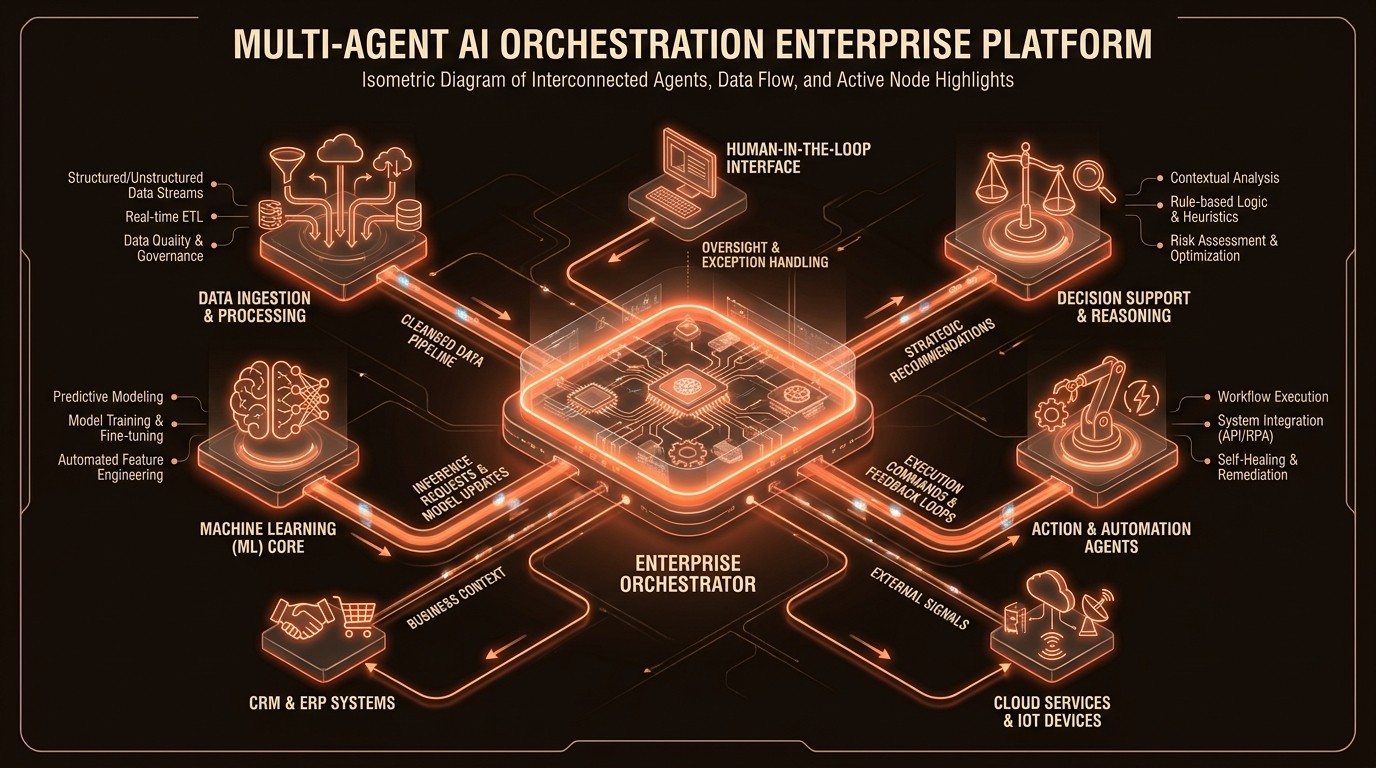
The core challenge lies in coordinating multiple AI agents to work towards shared goals, a task that requires sophisticated orchestration frameworks. Forrester's research indicates that 56% of organizations have improved scalability by implementing these frameworks. This improvement is crucial as businesses face increasing demands for efficiency and adaptability. The orchestration of AI agents allows enterprises to harness the full potential of AI, moving beyond isolated automation to a more integrated and intelligent system.
As McKinsey's State of AI report highlights, 23% of organizations are already scaling agentic AI systems, with 62% actively experimenting. This trend underscores the growing recognition of multi-agent AI orchestration as a key driver of innovation and value creation. McKinsey estimates that in the long term, enterprise use cases of generative AI could generate up to $4.4 trillion of value annually. The potential for revenue generation and customer satisfaction improvement is immense, as noted by industry experts.
Navigating the Challenges of Multi-Agent AI
Despite its potential, implementing multi-agent AI orchestration is not without challenges. One significant pain point is the complexity of integrating diverse AI agents into existing systems. Enterprises often have legacy systems that are not designed to accommodate the dynamic nature of AI agents. This integration challenge can lead to increased costs and delays, hindering the overall efficiency of the AI orchestration process.
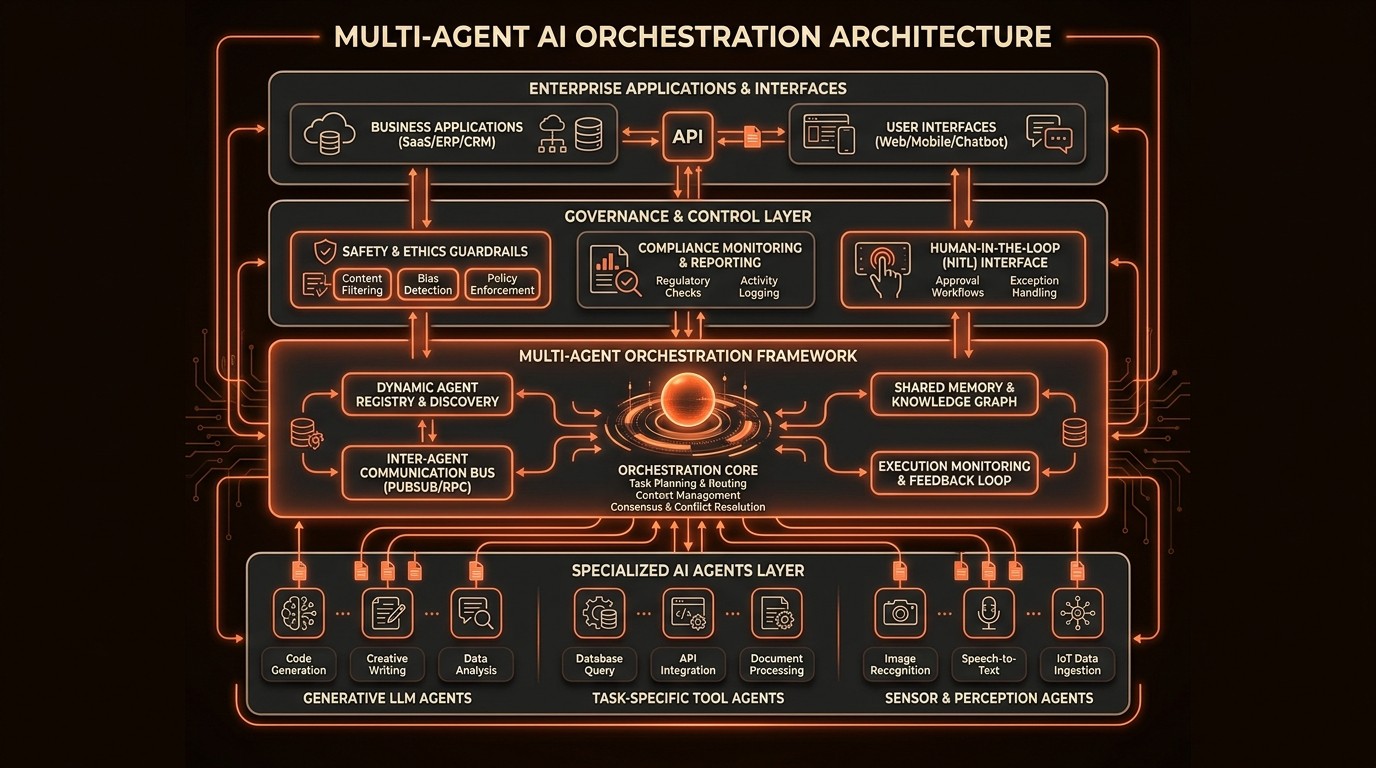
Another challenge is the governance and coordination of autonomous or semi-autonomous AI workers. As Markus Brinsa noted, agent orchestration involves runtime governance, including routing, permissioning, and policy enforcement. Without proper governance, the risk of AI agents operating in silos increases, leading to fragmented intelligence rather than a unified system. This fragmentation can result in inconsistent decision-making and reduced operational effectiveness.
Scalability is also a critical issue. While Forrester's data shows that 56% of organizations have improved scalability with orchestration frameworks, achieving this scalability requires significant investment in infrastructure and expertise. Enterprises must ensure that their systems can handle the increased data flow and processing demands that come with multi-agent AI orchestration.
Finally, there is the challenge of monitoring and evaluation. With multiple AI agents operating simultaneously, tracking performance and ensuring compliance with organizational goals becomes complex. Enterprises need robust monitoring systems to evaluate the effectiveness of their AI orchestration efforts and make necessary adjustments. Without these systems, the risk of inefficiencies and errors increases, potentially undermining the benefits of AI orchestration.
Understanding Multi-Agent AI Orchestration
To fully grasp the potential of multi-agent AI orchestration, it's essential to understand the core technologies and methodologies involved. At its heart, multi-agent AI orchestration is about coordinating multiple AI agents to achieve shared objectives. This coordination involves several key concepts, each playing a crucial role in the orchestration process.
AI Agents
AI agents are autonomous or semi-autonomous entities capable of performing specific tasks. These agents can operate independently or collaboratively, depending on the orchestration framework. They are designed to interact with their environment, make decisions, and learn from their experiences. The flexibility and adaptability of AI agents make them ideal for complex enterprise applications where dynamic decision-making is required.
Agentic AI
Agentic AI refers to AI systems that exhibit agency, meaning they can act independently to achieve specific goals. This concept is central to multi-agent AI orchestration, as it allows AI agents to operate autonomously while still being part of a larger, coordinated system. Agentic AI systems are designed to be adaptive, learning from their interactions and improving over time.
Orchestration Frameworks
Orchestration frameworks provide the infrastructure and tools necessary to manage and coordinate AI agents. These frameworks handle tasks such as routing, permissioning, and policy enforcement, ensuring that AI agents operate within defined parameters. By providing a structured environment for AI agents, orchestration frameworks enable enterprises to scale their AI operations effectively.
Governance and Monitoring
Effective governance and monitoring are critical components of multi-agent AI orchestration. Governance involves setting policies and guidelines for AI agent behavior, while monitoring ensures compliance with these policies. Enterprises need robust systems to track AI agent performance, evaluate outcomes, and make necessary adjustments. This oversight is essential for maintaining the integrity and effectiveness of the AI orchestration process.
By the Numbers
Here's what the data reveals:
Metric | Current State | Impact |
|---|---|---|
Enterprise software with agentic AI | Less than 1% in 2024 | 33% by 2028 |
Organizations improving scalability | 56% with orchestration frameworks | Enhanced efficiency |
Organizations scaling agentic AI | 23% currently | 62% experimenting |
Potential value from gen AI | Up to $4.4 trillion annually | Significant revenue growth |
Task-specific AI agents in applications | Less than 5% in 2025 | 40% by 2026 |
Unlocking the Potential of Multi-Agent AI
Enhanced Scalability
One of the primary benefits of multi-agent AI orchestration is enhanced scalability. By coordinating multiple AI agents, enterprises can handle larger volumes of data and more complex tasks. For example, a financial institution might use AI agents to process transactions, detect fraud, and manage customer interactions simultaneously. This scalability allows the institution to serve more customers efficiently, reducing wait times and improving customer satisfaction.
Improved Decision-Making
Multi-agent AI orchestration also improves decision-making by providing a more comprehensive view of enterprise operations. AI agents can analyze data from various sources, identify patterns, and make informed decisions. In a manufacturing setting, AI agents might monitor production lines, predict equipment failures, and optimize resource allocation. This data-driven decision-making leads to increased operational efficiency and reduced downtime.
Adaptive Intelligence
The adaptive nature of multi-agent AI systems allows enterprises to respond quickly to changing conditions. AI agents can learn from their interactions and adjust their behavior accordingly. In the retail industry, for example, AI agents might analyze customer preferences and adjust inventory levels in real-time. This adaptability ensures that enterprises can meet customer demands and stay competitive in a dynamic market.
Cost Reduction
Implementing multi-agent AI orchestration can also lead to significant cost reductions. By automating routine tasks and optimizing resource allocation, enterprises can reduce labor costs and improve resource utilization. In the healthcare sector, AI agents might automate administrative tasks, allowing healthcare professionals to focus on patient care. This shift not only reduces costs but also improves the quality of care provided.
In Practice
Financial Services
In the financial services industry, multi-agent AI orchestration is transforming how institutions manage risk and compliance. AI agents can monitor transactions in real-time, detect anomalies, and flag potential fraud. For instance, a bank might implement an orchestration framework to coordinate AI agents across its fraud detection, customer service, and compliance departments. This integration allows the bank to respond to threats more quickly and efficiently, reducing fraud losses by 30%.
Manufacturing
Manufacturers are leveraging multi-agent AI orchestration to optimize production processes and improve quality control. AI agents can monitor equipment performance, predict maintenance needs, and adjust production schedules. A manufacturing company might use AI agents to coordinate its supply chain, ensuring that materials are available when needed and reducing inventory costs by 20%. This orchestration leads to more efficient production and higher product quality.
Retail
In the retail sector, multi-agent AI orchestration is enhancing customer experiences and optimizing inventory management. AI agents can analyze sales data, predict demand, and adjust pricing strategies. A retailer might implement an orchestration framework to coordinate AI agents across its marketing, sales, and logistics departments. This integration allows the retailer to respond to market trends more quickly, increasing sales by 15%.
Industry Voices
McKinsey & Company has indicated in its research that generative AI agents are expected to improve customer satisfaction and drive revenue growth, becoming increasingly important for delivering new services and addressing broader customer needs in the near future.
Getting Started
Implementing multi-agent AI orchestration requires a strategic approach. Here are five steps to get started:
Audit Current Workflows: Begin by identifying the top three time-consuming processes within your organization. Document current processing times and error rates to establish baseline metrics for comparison after implementation. Map dependencies between tools and teams to understand the existing workflow landscape.
Define Objectives: Clearly define the objectives you aim to achieve with multi-agent AI orchestration. Whether it's improving scalability, enhancing decision-making, or reducing costs, having clear goals will guide your implementation strategy and help measure success.
Select the Right Tools: Choose orchestration frameworks and AI agents that align with your objectives. Consider factors such as scalability, integration capabilities, and ease of use. VideoDB can be a valuable tool in this process, offering robust features for managing and coordinating AI agents.
Implement and Test: Deploy the selected tools and frameworks in a controlled environment. Conduct thorough testing to ensure that AI agents operate as expected and that the orchestration framework effectively coordinates their activities. Monitor performance and make necessary adjustments.
Monitor and Optimize: Continuously monitor the performance of your multi-agent AI system. Use the data collected to identify areas for improvement and optimize the orchestration process. Regularly review objectives and adjust strategies to ensure alignment with organizational goals.
FAQ
Q: What is the difference between AI agents and traditional automation?
A: AI agents are autonomous entities capable of learning and adapting, while traditional automation relies on predefined rules. AI agents can operate independently, making decisions based on data, whereas traditional automation requires human intervention for changes.
Q: How does multi-agent AI orchestration improve scalability?
A: By coordinating multiple AI agents, orchestration frameworks enable enterprises to handle larger volumes of data and more complex tasks. This scalability allows organizations to serve more customers efficiently and reduce operational bottlenecks.
Q: What industries benefit most from multi-agent AI orchestration?
A: Industries such as financial services, manufacturing, and retail benefit significantly from multi-agent AI orchestration. These sectors can leverage AI agents to enhance decision-making, optimize processes, and improve customer experiences.
Q: How does governance play a role in AI orchestration?
A: Governance ensures that AI agents operate within defined parameters, maintaining compliance with organizational policies. It involves setting guidelines for agent behavior and monitoring performance to ensure alignment with business objectives.
Q: What are the cost implications of implementing multi-agent AI orchestration?
A: While initial implementation may require investment in infrastructure and expertise, the long-term benefits include reduced labor costs, improved resource utilization, and increased operational efficiency, leading to overall cost savings.
Key Takeaways
Multi-agent AI orchestration transforms fragmented automation into unified intelligence.
33% of enterprise software will include agentic AI by 2028, up from less than 1% in 2024.
56% of organizations improve scalability with orchestration frameworks.
$4.4 trillion in potential value from generative AI use cases annually.
Effective governance and monitoring are critical for successful AI orchestration.