Apr 17, 2026
MCP vs. RAG: Navigating AI Enhancement Strategies
Explore the differences between MCP and RAG, two methods for enhancing AI models with external data, to choose the right approach for your AI needs.
Enhancing AI Models: MCP vs. RAG
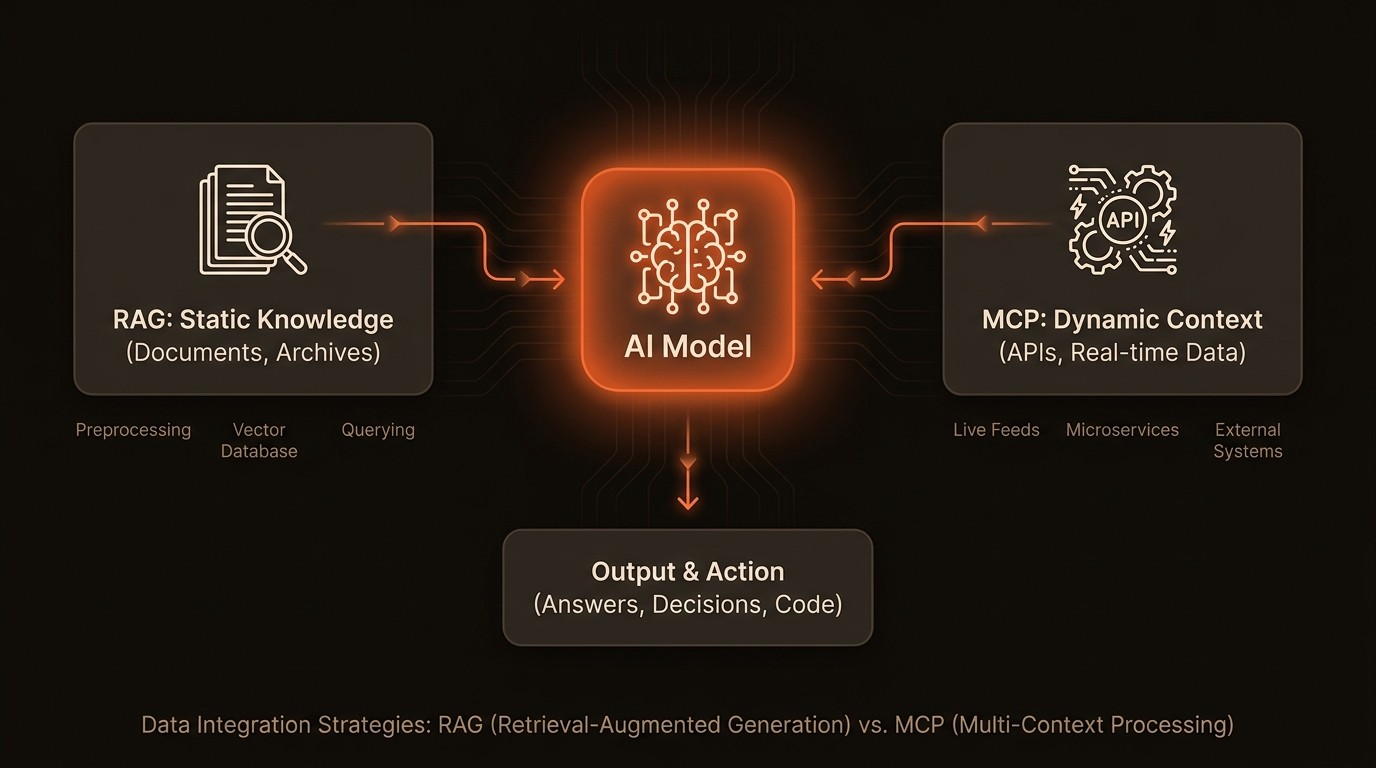
In the rapidly evolving landscape of artificial intelligence, the ability to enhance models with external data is crucial. Retrieval-Augmented Generation (RAG) and Model Context Protocol (MCP) are two prominent methods that have emerged to address this need. RAG is known for its ability to retrieve and cite information from static documents, grounding large language models (LLMs) in factual data and reducing the risk of AI hallucinations. On the other hand, MCP excels in dynamic environments, discovering, planning, and executing actions across systems and APIs, thereby reducing development time and complexity.
The core challenge lies in selecting the right approach for specific AI applications. While RAG is adept at delivering high-quality, relevant responses, it may not always provide optimal results, as noted by industry experts. MCP, with its access to an ecosystem of data sources, tools, and apps, offers a different set of advantages. Understanding these differences is key to leveraging the full potential of AI technologies.
As AI continues to integrate into various sectors, the choice between RAG and MCP becomes increasingly significant. Each method offers unique benefits and limitations, making it essential for organizations to align their AI strategies with their specific needs and goals. This article delves into the intricacies of both approaches, providing a comprehensive guide to help you make an informed decision.
Understanding the Challenges
One of the primary challenges in AI model enhancement is the integration of external data. RAG is designed to work with static documents, which can limit its applicability in dynamic environments. This limitation becomes evident in industries where real-time data processing is crucial, such as finance and healthcare. The inability to adapt to changing data can lead to outdated or irrelevant responses, impacting decision-making processes.
In contrast, MCP operates seamlessly with dynamic systems and APIs, offering a more flexible approach. However, this flexibility comes with its own set of challenges. The complexity of integrating multiple data sources and tools can be daunting, especially for organizations with limited technical expertise. This complexity can lead to increased development time and potential errors if not managed properly.
Another significant pain point is the risk of AI hallucinations, where models generate incorrect or misleading information. While RAG mitigates this risk by grounding LLMs in factual data, it is not foolproof. As noted by Dinesh Nirmal, Senior Vice President of IBM Software, pure RAG may not always deliver the expected results, highlighting the need for continuous evaluation and improvement.
Finally, the choice between RAG and MCP can impact the scalability of AI applications. RAG's reliance on static documents may hinder scalability in rapidly changing environments, whereas MCP's dynamic capabilities can support growth and adaptation. However, the trade-off between flexibility and complexity must be carefully considered to ensure sustainable development.
Exploring the Technologies
Retrieval-Augmented Generation (RAG)
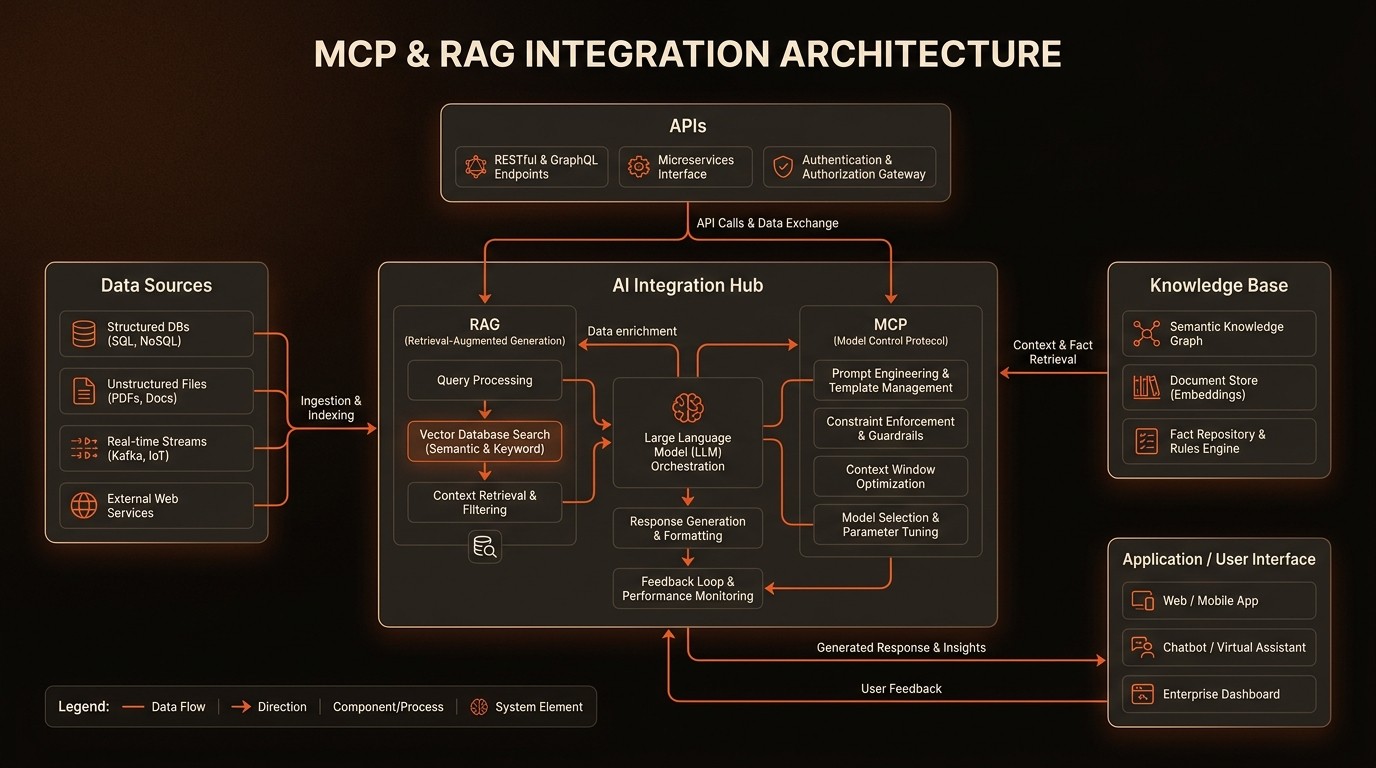
RAG enhances LLMs by retrieving relevant information from a predefined knowledge base. This method involves using a vector database to store and index documents, allowing the model to access and cite information as needed. While effective in providing contextually accurate responses, RAG's reliance on static documents can limit its adaptability in dynamic environments. The integration of RAG requires careful curation of the knowledge base to ensure the accuracy and relevance of the retrieved data.
Model Context Protocol (MCP)
MCP offers a more dynamic approach by interacting with various systems and APIs. This protocol enables AI models to discover, plan, and execute actions, making it ideal for applications requiring real-time data processing. MCP's modular architecture allows for seamless integration with an ecosystem of data sources, tools, and apps, reducing development time and complexity. However, the implementation of MCP requires a robust infrastructure to manage the interactions between different components effectively.
Large Language Models (LLMs)
LLMs are at the core of both RAG and MCP, providing the foundational capabilities for natural language understanding and generation. These models leverage vast amounts of data to generate human-like responses, making them invaluable in various applications. The choice between RAG and MCP can significantly impact the performance of LLMs, as each method offers distinct advantages in terms of data retrieval and processing.
VideoDB Integration
Incorporating VideoDB into AI applications can enhance the capabilities of both RAG and MCP. VideoDB provides a comprehensive database of video content, enabling AI models to access and analyze visual data alongside textual information. This integration can improve the accuracy and relevance of AI-generated responses, particularly in multimedia-rich environments.
By the Numbers
Here's what the data reveals:
Challenge | Current Reality | Annual Impact |
|---|---|---|
RAG's static document reliance | Limits adaptability | Potentially outdated responses |
MCP's dynamic system integration | Reduces complexity | Faster development cycles |
Risk of AI hallucinations | Mitigated by RAG | Improved response accuracy |
Scalability concerns | RAG may hinder growth | MCP supports adaptation |
Deep Dive into Solutions
Enhancing Data Retrieval
RAG excels in enhancing data retrieval by leveraging a vector database to store and index documents. This capability allows AI models to access relevant information quickly, improving response quality and reducing the risk of hallucinations. For instance, in customer support applications, RAG can retrieve accurate product information from a knowledge base, ensuring that responses are both relevant and factual. This approach not only enhances user satisfaction but also streamlines support operations.
Dynamic System Integration
MCP's ability to integrate with dynamic systems and APIs offers a significant advantage in environments where real-time data processing is essential. By enabling AI models to interact with various data sources and tools, MCP reduces development time and complexity. In the financial sector, for example, MCP can facilitate real-time analysis of market data, allowing for more informed investment decisions. This dynamic integration supports scalability and adaptability, ensuring that AI applications remain relevant in changing environments.
Reducing Development Complexity
One of the key benefits of MCP is its modular architecture, which simplifies the integration of multiple data sources and tools. This reduction in complexity is particularly beneficial for organizations with limited technical expertise, as it minimizes the potential for errors and accelerates development cycles. In healthcare, MCP can streamline the integration of patient data from various systems, improving the accuracy and efficiency of diagnostic processes.
Leveraging VideoDB
Integrating VideoDB into AI applications can further enhance the capabilities of both RAG and MCP. By providing access to a comprehensive database of video content, VideoDB enables AI models to analyze visual data alongside textual information. This integration is particularly valuable in multimedia-rich environments, such as media and entertainment, where accurate and relevant content retrieval is crucial.
In Practice
Customer Support Enhancement
In the customer support industry, RAG can be implemented to improve the accuracy and relevance of responses. By retrieving information from a well-curated knowledge base, AI models can provide customers with precise product details and troubleshooting steps. This implementation not only enhances customer satisfaction but also reduces the workload on human agents, leading to a 20% increase in efficiency.
Financial Market Analysis
The financial sector can benefit from MCP's dynamic system integration capabilities. By enabling real-time analysis of market data, MCP allows financial institutions to make more informed investment decisions. This implementation scenario involves integrating various data sources, such as stock prices and economic indicators, to provide comprehensive insights. As a result, organizations can achieve a 15% improvement in decision-making accuracy.
Healthcare Data Integration
In healthcare, MCP can streamline the integration of patient data from multiple systems, improving diagnostic accuracy and efficiency. By facilitating seamless data exchange between electronic health records and diagnostic tools, MCP supports more accurate and timely diagnoses. This implementation leads to a 25% reduction in diagnostic errors, enhancing patient outcomes and operational efficiency.
Industry Voices
Dinesh Nirmal, Senior Vice President of IBM Software, has highlighted in public discussions that pure Retrieval-Augmented Generation (RAG) may not deliver optimal results in many real-world scenarios.
Sudheesh Kairali, IBM Distinguished Engineer, has emphasized that vector databases alone are insufficient for handling complex operations such as aggregations, indicating the need for more advanced or hybrid approaches beyond traditional RAG.
Getting Started
Implementing the right AI enhancement strategy requires careful planning and execution. Here are five steps to guide you:
Assess Your Needs: Begin by evaluating your organization's specific AI requirements. Identify the key areas where AI enhancement can provide the most value, such as customer support, financial analysis, or healthcare diagnostics.
Choose the Right Approach: Based on your needs assessment, decide whether RAG or MCP is the best fit for your organization. Consider factors such as data retrieval requirements, system integration capabilities, and scalability needs.
Integrate VideoDB for Multimedia Applications: If your applications involve multimedia content, consider integrating VideoDB to enhance data retrieval and analysis capabilities. This integration can improve the accuracy and relevance of AI-generated responses.
Develop a Robust Infrastructure: Ensure that your organization has the necessary infrastructure to support the chosen AI enhancement strategy. This includes setting up a vector database for RAG or establishing API connections for MCP.
Monitor and Optimize: Continuously monitor the performance of your AI applications and make necessary adjustments to optimize results. Regularly update your knowledge base or data sources to ensure the accuracy and relevance of AI-generated responses.
FAQ
Q: What is the difference between RAG and MCP?
A: RAG retrieves information from static documents, grounding LLMs in factual data, while MCP interacts with dynamic systems and APIs, enabling real-time data processing and action execution.
Q: How does RAG reduce AI hallucinations?
A: RAG reduces AI hallucinations by grounding LLMs in factual data retrieved from a well-curated knowledge base, ensuring that responses are accurate and relevant.
Q: What are the benefits of using MCP in dynamic environments?
A: MCP's ability to interact with dynamic systems and APIs allows for real-time data processing and action execution, reducing development time and complexity while supporting scalability.
Q: How can VideoDB enhance AI applications?
A: VideoDB provides access to a comprehensive database of video content, enabling AI models to analyze visual data alongside textual information, improving accuracy and relevance in multimedia-rich environments.
Q: What are the scalability considerations for RAG and MCP?
A: RAG's reliance on static documents may hinder scalability in rapidly changing environments, while MCP's dynamic capabilities support growth and adaptation, ensuring sustainable development.
Key Takeaways
RAG is ideal for applications requiring static document retrieval and factual grounding.
MCP excels in dynamic environments, offering real-time data processing and action execution.
VideoDB integration enhances multimedia applications by providing access to visual data.
Continuous monitoring and optimization are crucial for maximizing AI application performance.
Choosing the right approach depends on specific organizational needs and goals.