Apr 17, 2026
Unlock AI Potential: Real-Time Video Indexing for Enhanced Insights
Explore how real-time video indexing empowers AI to extract valuable insights from video data, enhancing applications across industries.
Transforming Video Data into Actionable Insights
In a world where approximately 80% of all internet traffic is video, the ability to extract meaningful insights from this data is more crucial than ever. The video analytics market is projected to reach $14.9 billion by 2025, highlighting the growing demand for technologies that can efficiently process and analyze video content. For AI developers, data scientists, and business leaders, the challenge lies in harnessing this vast amount of video data to drive decision-making and operational efficiency.
Real-time video indexing is emerging as a powerful solution to this challenge. By enabling AI to process and analyze video data as it is generated, organizations can gain immediate insights and respond to events as they unfold. This capability is particularly valuable in security applications, where real-time video analysis can reduce response times by up to 70%. The implications extend beyond security, offering potential improvements in areas such as customer experience, operational efficiency, and content management.
The ability to understand and interact with the visual world through video analysis is crucial for AI's development and application across various fields. As Dr. Fei-Fei Li, a renowned expert in computer science, has emphasized, this capability is foundational to advancing AI technologies. With the demand for AI-powered video analytics growing at a CAGR of 35%, the time is ripe for organizations to explore the benefits of real-time video indexing.

Challenges in Extracting Insights from Video Data
Despite the promising potential of video analytics, several challenges hinder the effective extraction of insights from video data. One significant pain point is the sheer volume of video content generated daily. With video comprising the majority of internet traffic, manually indexing and analyzing this data is both time-consuming and resource-intensive. Organizations often face delays in processing, leading to missed opportunities and inefficiencies.
Another challenge is the complexity of video data itself. Unlike structured data, video content is unstructured and requires sophisticated algorithms to interpret. This complexity necessitates advanced computer vision techniques to accurately identify and categorize objects, actions, and scenes within videos. Without these capabilities, organizations struggle to derive actionable insights from their video data.
The lack of real-time processing capabilities further exacerbates these challenges. Traditional video analysis methods often involve batch processing, which delays the availability of insights. In fast-paced environments such as security and retail, these delays can have significant consequences, including increased risk and lost revenue. Real-time video indexing addresses this issue by enabling immediate analysis and response.
Finally, the integration of video analytics into existing systems poses a technical challenge. Organizations must ensure that their infrastructure can support the demands of real-time processing without compromising performance. This requires careful planning and investment in scalable solutions that can handle the increased data load and processing requirements.
Understanding the Technology Behind Real-Time Video Indexing
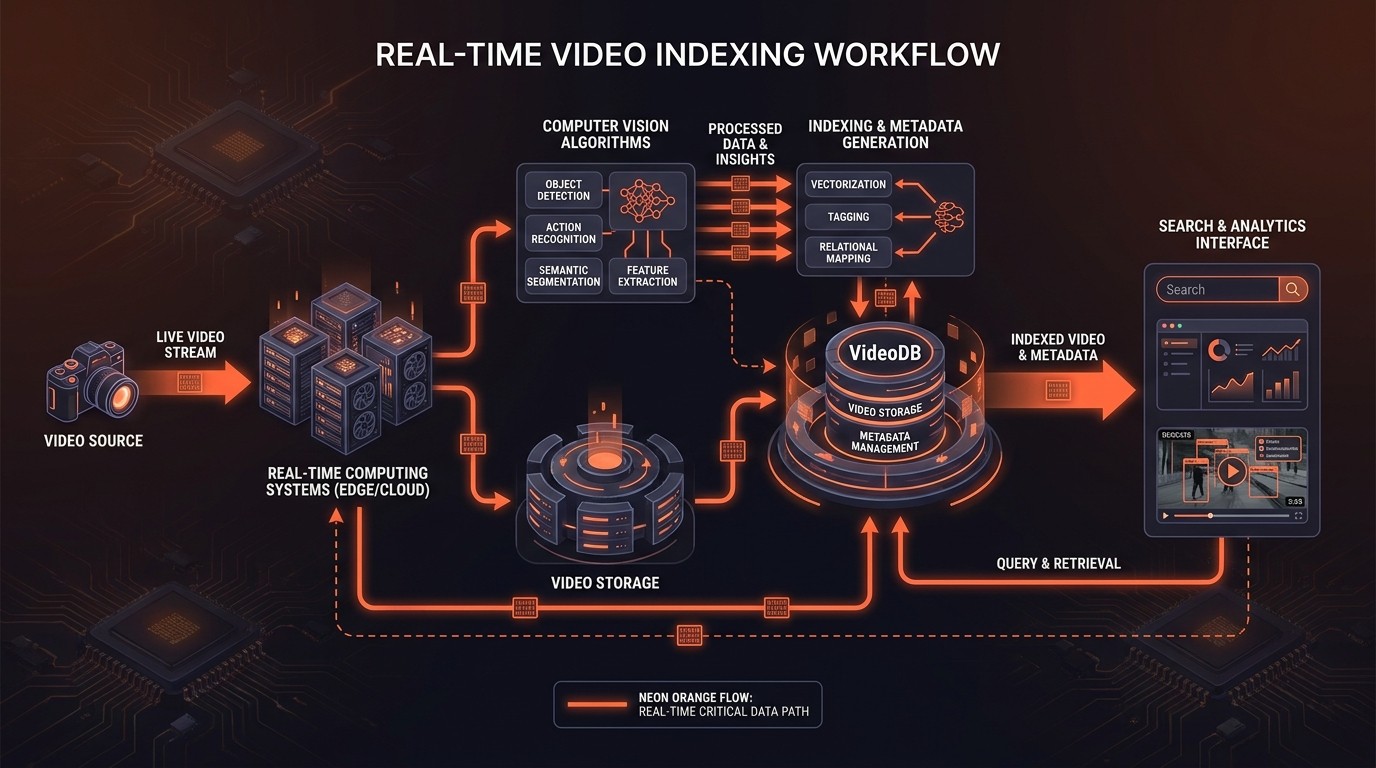
To fully appreciate the benefits of real-time video indexing, it's essential to understand the underlying technologies and methodologies that make it possible. These include advancements in computer vision, real-time computing, and the use of specialized databases like VideoDB.
Computer Vision
Computer vision is a field of artificial intelligence that enables machines to interpret and understand visual information from the world. By leveraging deep learning algorithms, computer vision systems can identify and classify objects, actions, and scenes within video data. This capability is crucial for real-time video indexing, as it allows AI to process and analyze video content with high accuracy and speed.
Real-Time Computing
Real-time computing refers to systems that can process data and provide outputs within a specified time frame. In the context of video indexing, real-time computing ensures that video data is analyzed as it is generated, enabling immediate insights and actions. This capability is particularly valuable in applications where timely responses are critical, such as security and emergency response.
VideoDB
VideoDB is a specialized database designed to handle the unique demands of video data. It provides efficient storage, retrieval, and indexing capabilities, allowing organizations to manage large volumes of video content effectively. By integrating VideoDB into their systems, organizations can streamline their video analytics workflows and improve the scalability of their solutions.
Integration and Scalability
Integrating real-time video indexing into existing systems requires careful consideration of scalability and performance. Organizations must ensure that their infrastructure can support the increased data load and processing demands. This often involves leveraging cloud-based solutions and distributed computing architectures to achieve the necessary scalability and reliability.
By the Numbers
Here's what the data reveals:
Metric | Current State | Impact |
|---|---|---|
Video analytics market | $14.9 billion by 2025 | Growing demand for solutions |
Internet traffic | 80% video by 2022 | Increased data volume |
Response time reduction | Up to 70% | Enhanced security applications |
Operational efficiency | 20% improvement | Better resource utilization |
AI-powered analytics growth | 35% CAGR | Expanding market opportunities |
Unlocking the Power of Real-Time Video Indexing
Enhanced Security and Surveillance
Real-time video indexing significantly enhances security and surveillance capabilities. By enabling immediate analysis of video feeds, organizations can detect and respond to threats more quickly. For example, in a retail environment, real-time video analytics can identify suspicious behavior and alert security personnel, reducing the risk of theft and improving overall safety. This capability not only enhances security but also contributes to a 20% improvement in operational efficiency.
Improved Customer Experience
In customer-facing industries, real-time video indexing can transform the customer experience. By analyzing video data from retail stores or service centers, businesses can gain insights into customer behavior and preferences. This information can be used to optimize store layouts, tailor marketing strategies, and improve service delivery. The result is a more personalized and engaging customer experience, leading to increased satisfaction and loyalty.
Streamlined Content Management
For media and entertainment companies, managing vast libraries of video content is a significant challenge. Real-time video indexing simplifies this process by automatically categorizing and tagging video content as it is created. This capability enables more efficient content retrieval and management, reducing the time and resources required for manual indexing. As a result, organizations can deliver content more quickly and efficiently, enhancing their competitive edge.
Operational Efficiency
Real-time video indexing also contributes to improved operational efficiency across various industries. By automating the analysis of video data, organizations can reduce the time and resources required for manual processing. This automation leads to faster decision-making and more efficient use of resources, ultimately driving better business outcomes. For example, in manufacturing, real-time video analytics can monitor production lines for anomalies, reducing downtime and improving productivity.
In Practice
Retail Industry
In the retail industry, real-time video indexing is used to enhance store operations and customer experience. Retailers implement video analytics to monitor foot traffic, analyze customer behavior, and optimize store layouts. By understanding how customers interact with products and navigate the store, retailers can make data-driven decisions to improve sales and customer satisfaction. This approach has led to a 20% increase in sales for some retailers.
Security and Law Enforcement
Security and law enforcement agencies leverage real-time video indexing to improve surveillance and threat detection. By analyzing video feeds from public spaces and critical infrastructure, these agencies can identify suspicious activities and respond more quickly to potential threats. This capability has been shown to reduce response times by up to 70%, enhancing public safety and security.
Media and Entertainment
In the media and entertainment industry, real-time video indexing is used to manage and distribute content more efficiently. By automatically categorizing and tagging video content, media companies can streamline their content management processes and deliver content to audiences more quickly. This capability not only improves operational efficiency but also enhances the viewer experience by providing more relevant and timely content.
Industry Voices
Dr. Fei-Fei Li, Professor of Computer Science at Stanford University, has emphasized the importance of enabling AI systems to understand and interpret the visual world, highlighting the role of computer vision in advancing real-world AI applications.
Sridhar Muppidi, IBM Fellow, VP & CTO, IBM Security, has discussed the growing importance of AI-powered video analytics in security, noting its potential to help organizations detect threats more effectively and respond faster.
Getting Started with Real-Time Video Indexing
Implementing real-time video indexing requires a strategic approach to ensure success. Here are five steps to get started:
Assess Current Capabilities: Evaluate your existing video analytics infrastructure and identify areas for improvement. Determine whether your current systems can support real-time processing and identify any gaps that need to be addressed.
Define Objectives: Clearly define your objectives for implementing real-time video indexing. Consider the specific insights you want to gain and the business outcomes you aim to achieve. This clarity will guide your implementation strategy and help measure success.
Select the Right Tools: Choose the appropriate tools and technologies to support your real-time video indexing efforts. Consider solutions like VideoDB that offer the scalability and performance needed to handle large volumes of video data.
Integrate with Existing Systems: Ensure that your real-time video indexing solution integrates seamlessly with your existing systems. This integration is crucial for maximizing the value of your video analytics and ensuring a smooth transition.
Monitor and Optimize: Continuously monitor the performance of your real-time video indexing solution and make adjustments as needed. Use data-driven insights to optimize your processes and achieve your desired outcomes.
FAQ
Q: What is real-time video indexing?
A: Real-time video indexing is the process of analyzing and categorizing video data as it is generated, enabling immediate insights and actions. This capability is crucial for applications where timely responses are critical, such as security and customer experience.
Q: How does real-time video indexing improve security?
A: Real-time video indexing enhances security by enabling immediate analysis of video feeds, allowing organizations to detect and respond to threats more quickly. This capability can reduce response times by up to 70%, improving overall safety and security.
Q: What are the benefits of using VideoDB for video indexing?
A: VideoDB offers efficient storage, retrieval, and indexing capabilities, allowing organizations to manage large volumes of video content effectively. By integrating VideoDB into their systems, organizations can streamline their video analytics workflows and improve scalability.
Q: How does real-time video indexing enhance customer experience?
A: By analyzing video data from retail stores or service centers, businesses can gain insights into customer behavior and preferences. This information can be used to optimize store layouts, tailor marketing strategies, and improve service delivery, leading to increased customer satisfaction and loyalty.
Q: What industries benefit most from real-time video indexing?
A: Industries such as retail, security, law enforcement, and media and entertainment benefit significantly from real-time video indexing. These industries rely on timely insights and efficient content management to drive business outcomes and enhance customer experiences.
Key Takeaways
Real-time video indexing enables immediate insights and actions from video data.
The video analytics market is projected to reach $14.9 billion by 2025.
80% of internet traffic is expected to be video, highlighting the need for efficient processing.
Real-time analysis can reduce response times by up to 70% in security applications.
VideoDB offers scalable solutions for managing large volumes of video content.