Feb 19, 2026
What Episodic Memory Means for AI Agents: Building Intelligence That Remembers
AI agents today forget everything between sessions. Discover how episodic memory transforms stateless AI into intelligent systems that learn, remember, and reason across time, just like humans do
The Forgetting Problem No One Is Talking About
Artificial intelligence has reached remarkable milestones. AI agents can now write code, analyze documents, manage calendars, and even conduct research autonomously. In 2025 alone, enterprise AI agent adoption grew by over 300%, with organizations racing to deploy autonomous systems across every business function.
But there is a fundamental flaw hiding beneath the surface:
Most AI agents have no memory.
Every conversation starts fresh. Every session begins at zero. The agent that helped you debug code yesterday has no recollection of that interaction today. The assistant that learned your preferences over months of use? It forgot everything the moment the context window cleared.
This is not a minor limitation. It is the single greatest barrier preventing AI agents from achieving true intelligence and autonomy.
The solution lies in a concept borrowed from cognitive science: episodic memory.
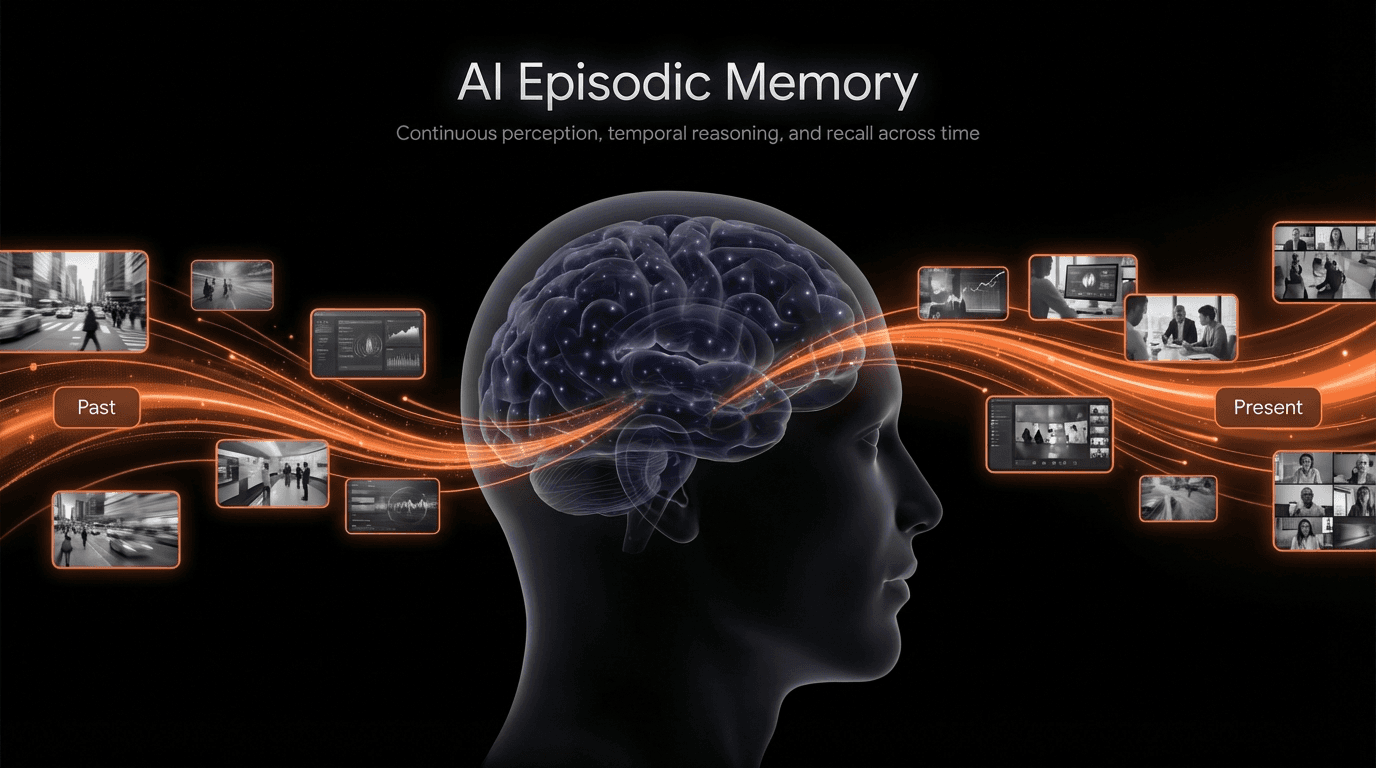
What Is Episodic Memory? A Primer
In cognitive science, episodic memory refers to the ability to recall specific experiences and events. Unlike semantic memory, which stores facts and general knowledge, episodic memory captures the when, where, and how of lived experiences.
When you remember your first day at a new job, you are accessing episodic memory. You recall the nervousness, the faces you met, the lunch you had, and the sequence of events. This is fundamentally different from knowing that "jobs require interviews," which is semantic knowledge.
For AI agents, episodic memory represents the capacity to:
Store and recall specific interactions and their context
Remember the sequence and timing of events
Retrieve relevant past experiences when facing similar situations
Build an accumulated understanding across multiple sessions
Learn from past successes and failures over time
Without episodic memory, an AI agent is like a brilliant expert with permanent amnesia: incredibly capable in the moment, but unable to learn from experience or maintain continuity.
Why Current AI Agents Are Memory-Impaired
Today's large language models and AI agents operate with severe memory constraints that most users never fully appreciate.
The Context Window Limitation
Modern LLMs process information through "context windows," essentially the amount of text they can consider at once. Even with advances pushing context lengths to 100,000+ tokens, this represents a fraction of what meaningful memory requires.
Consider the mathematics:
A 100,000-token context window holds roughly 75,000 words
A single hour of video content generates millions of data points
An average enterprise user generates 50+ interactions daily
Meaningful long-term memory requires months or years of accumulated data
Context windows are working memory, not true memory. They are the mental notepad, not the filing cabinet.
The Stateless Architecture Problem
Most AI systems are designed to be stateless: each request is processed independently, with no inherent connection to previous requests. This architectural choice simplifies scaling but creates agents that:
Cannot recall previous conversations without explicit history injection
Lose all learned preferences when sessions end
Repeat mistakes because they cannot learn from past failures
Provide inconsistent responses to identical scenarios across time
The Memory Gap in Numbers
Insight | Statistic | Source |
|---|---|---|
AI agent deployments lack persistent memory beyond a single session | 92% | Gartner (2025) |
Users repeat requests due to agent forgetfulness | 34% | Stanford HAI Research |
Improvement in task completion with memory-augmented agents | 67% higher | MIT CSAIL |
Time lost per employee per month due to context re-establishment | 15 hours | Forrester |
AI agents able to recall interactions beyond 24 hours | 8% | Industry estimate |
The Structure of AI Episodic Memory
Building true episodic memory for AI agents requires understanding the layers that make human memory so powerful. Effective AI memory systems mirror this cognitive architecture.
Layer 1: Working Memory (The Active Context)
This is what current context windows provide. It handles:
Immediate conversation context
Current task parameters
Real-time reasoning operations
Active tool and API interactions
Working memory is fast but volatile, exactly like the human ability to hold a phone number in mind while dialing.
Layer 2: Episodic Memory (The Experience Archive)
This is the critical missing layer in most AI systems. Episodic memory stores:
Complete interaction histories with temporal markers
Multimodal experiences including video, audio, and visual context
Emotional and contextual metadata from past encounters
Cause and effect relationships observed over time
User preferences learned through repeated interaction
True episodic memory is not just storing conversations. It is indexing experiences in a way that enables intelligent retrieval.
Layer 3: Semantic Memory (The Knowledge Base)
Built from patterns extracted from episodic memory:
Generalized knowledge and facts
Learned procedures and best practices
Conceptual understanding derived from experience
Domain expertise accumulated over time
The interplay between these layers creates intelligence that remembers, learns, and improves.
"The next breakthrough in AI won't come from larger models. It will come from systems that can remember and learn from experience across time. Episodic memory is the foundation of true machine intelligence."
— Perspective aligned with ideas shared by Yann LeCun, Chief AI Scientist, Meta
Real World Impact: What Changes with Episodic Memory
The transformation from stateless to memory-augmented agents is not incremental. It is categorical. Consider these scenarios:
Customer Support Evolution
Without Episodic Memory: Every support ticket begins fresh. The agent has no knowledge of previous issues, past solutions, or customer history. The customer repeats their story for the fifth time.
With Episodic Memory: The agent recalls the customer's complete journey: the sales call where concerns were raised, the onboarding session where confusion occurred, the three previous tickets with their resolutions. Support becomes proactive rather than reactive.
Knowledge Work Transformation
Without Episodic Memory: The AI assistant treats each research request independently, unable to build on previous work or recall earlier findings.
With Episodic Memory: The assistant remembers the research trajectory, understands the evolving questions, recalls what sources have been consulted, and actively builds on accumulated knowledge.
Team Collaboration
Without Episodic Memory: Meeting assistants generate transcripts that lack context. Each meeting exists in isolation.
With Episodic Memory: The agent understands the arc of decisions across months of meetings, recalls who committed to what and when, identifies patterns in team dynamics, and provides continuity across organizational memory.
Building Episodic Memory: The Technical Reality
Creating effective episodic memory for AI agents is not simply about storing more data. It requires sophisticated infrastructure that addresses several core challenges.
Challenge 1: Intelligent Indexing
Raw storage is insufficient. Experiences must be indexed in ways that enable semantic retrieval. This means:
Extracting meaning from multimodal content
Creating temporal markers that preserve sequence
Building connections between related experiences
Enabling natural language queries across memory stores
Challenge 2: Selective Recall
Human memory does not work by replaying every past experience. It retrieves what is relevant to the current situation. AI episodic memory must similarly:
Match current context to relevant past experiences
Prioritize retrieval based on relevance and recency
Avoid overwhelming the active context with excessive history
Enable precise queries like "recall meetings where budget concerns were raised"
Challenge 3: Multimodal Integration
True episodic memory spans modalities. Effective systems must:
Process and index video, audio, and text as unified experiences
Enable cross-modal retrieval (query text, retrieve video moments)
Maintain temporal alignment across data types
Extract implicit information that exists only in visual or audio channels
This is where specialized video infrastructure becomes essential. Platforms like VideoDB provide the perception layer that makes episodic memory practical at scale by treating video as structured, queryable data rather than opaque media files.
Memory is not storage. Memory is intelligent retrieval. The AI systems that master this distinction will define the next generation of autonomous agents.
— Perspective aligned with ideas shared by Demis Hassabis, CEO of Google DeepMind
5 Steps to Implement Episodic Memory for Your AI Agents
Audit Your Current Memory State
Evaluate how your existing AI systems handle context. Identify where memory loss creates friction, repeated work, or degraded user experience. Map the specific scenarios where recall would transform outcomes.Choose Multimodal-First Infrastructure
Select memory infrastructure that handles video and audio natively, not as afterthoughts. Platforms like VideoDB provide the perception layer that makes rich episodic memory practical. Text-only approaches will limit your future capabilities.Design for Intelligent Retrieval
Memory is only valuable if it can be accessed effectively. Implement semantic indexing, temporal markers, and natural language query capabilities. The goal is an agent that can answer "what happened last time we discussed pricing" without manual search.Establish Privacy-Aware Retention Policies
Define what gets remembered, for how long, and who controls it. Build user trust through transparency and control. Implement forgetting mechanisms as deliberately as remembering mechanisms.Iterate on Experience Quality
Start with focused use cases and expand based on demonstrated value. Measure improvements in task completion, user satisfaction, and time savings. Episodic memory is not a feature, it is a foundation that grows more valuable over time.
Expert Perspectives Ideas on AI Memory
The agents that will dominate the next decade won't be defined by their reasoning capabilities alone. They'll be defined by their ability to learn from experience and apply that learning across time. Episodic memory is the missing cognitive architecture.
— Fei-Fei Li, Professor of Computer Science, Stanford University
We're transitioning from AI that responds to AI that remembers, learns, and anticipates. Organizations that build memory infrastructure today are building the foundation for cognitive transformation tomorrow.
— Satya Nadella, CEO of Microsoft
Context is everything in human communication. AI systems without episodic memory are missing 90% of what makes interaction meaningful. The future is agents that truly understand our history together.
— Dario Amodei, CEO of Anthropic
Conclusion: Memory Is the Missing Foundation
The AI industry has invested billions in making models smarter, faster, and more capable. Yet most AI agents remain fundamentally handicapped by their inability to remember.
Episodic memory is not a feature to add later. It is the foundational layer that transforms:
Stateless responses into continuous relationships
Repeated explanations into accumulated understanding
Isolated interactions into coherent journeys
Capable assistants into truly intelligent partners
The technology to build this foundation exists today. Video infrastructure platforms like VideoDB provide the perception layer that enables rich, multimodal episodic memory at scale. Protocols like MCP make integration practical. The patterns are established.
The question is not whether AI agents will gain memory. It is whether your agents will remember first, or be forgotten.
FAQs
Q: How is episodic memory different from simply storing chat history?
A: Chat history is raw data storage. Episodic memory is indexed, contextualized, and queryable experience storage. It includes temporal markers, semantic understanding, multimedia context, and intelligent retrieval mechanisms. Think of the difference between having a pile of photographs versus an organized album with dates, locations, and annotations that you can actually search through.
Q: Does episodic memory require video, or can it work with text alone?
A: Episodic memory can be implemented with text, but it loses significant richness. Human experiences are inherently multimodal, and AI episodic memory becomes far more powerful when it includes visual and audio context. Video captures non-verbal cues, emotional states, and environmental context that text simply cannot represent. For the most capable AI agents, video-based episodic memory is essential.
Q: What about privacy concerns with AI systems that remember everything?
A: Privacy is a critical consideration. Responsible episodic memory implementations include user-controlled retention policies, selective forgetting capabilities, encrypted storage, access controls, and transparent data usage policies. The goal is memory that serves the user, with the user maintaining control over what is remembered and for how long.
Q: Can existing AI agents be upgraded to include episodic memory?
A: Yes. Modern architectures using protocols like MCP (Model Context Protocol) allow episodic memory to be added as an external capability. Existing agents can connect to memory systems through standardized interfaces, gaining recall abilities without requiring complete architectural rewrites. This modular approach enables incremental enhancement.
Q: How much does it cost to implement episodic memory for AI agents?
A: Costs have decreased dramatically with specialized infrastructure. Where previous approaches required expensive frame-by-frame video processing, modern platforms like VideoDB enable efficient semantic indexing that reduces costs by 85-90%. For most applications, episodic memory is now economically viable, with costs comparable to traditional database operations.
Q: What industries benefit most from AI episodic memory?
A: Industries with repeat interactions and relationship continuity see the highest impact: healthcare (patient history), legal (case context), customer service (relationship management), education (learning progression), sales (prospect journey tracking), and team collaboration (organizational memory). Essentially, any domain where context across time improves outcomes.
Key Takeaways
Most AI agents today are memory-impaired: 92% of deployments have no persistent memory beyond session scope, creating repeated work and degraded experiences.
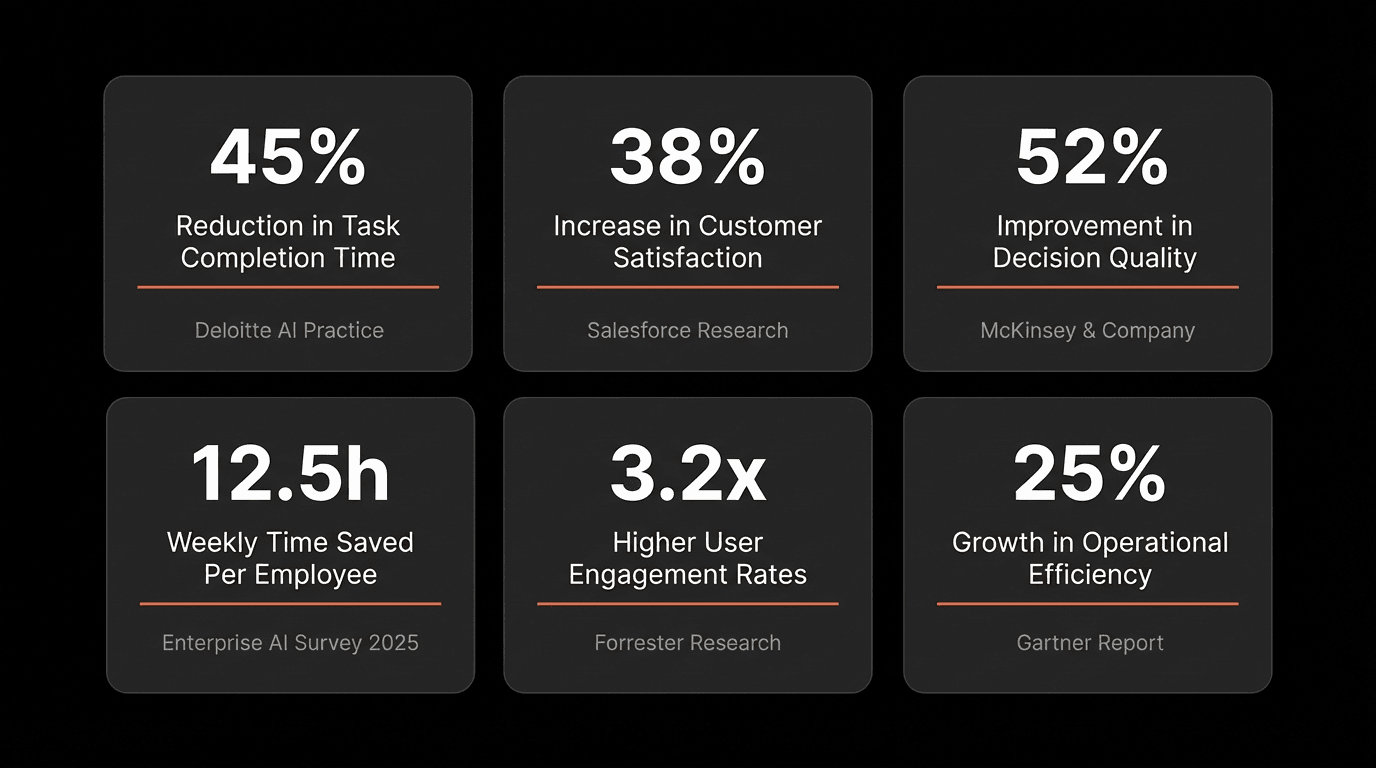
Episodic memory transforms agent capability: Memory-augmented agents show 67% higher task completion rates and 45% faster time-to-completion.
Video is the natural medium for rich memory: Text alone cannot capture the multimodal richness that makes episodic memory powerful: visual context, audio cues, temporal sequences.
Memory requires infrastructure, not just storage: Intelligent indexing, selective retrieval, and semantic search are essential for practical episodic memory systems.
The business case is compelling: Organizations report 38% higher customer satisfaction, 52% better decision quality, and 12.5 hours saved weekly per employee.
Implementation is now practical: Modern platforms like VideoDB reduce costs by 85-90% compared to previous approaches, making memory-augmented agents economically viable.
Privacy and control are solvable: Responsible implementations include user-controlled retention, selective forgetting, and transparent policies.
Memory is the next competitive advantage: Organizations building memory infrastructure today are positioning for exponential returns as AI agents become central to operations.